What's the Difference Between Custom, Semi-Custom, and Stock Kitchen Cabinets?
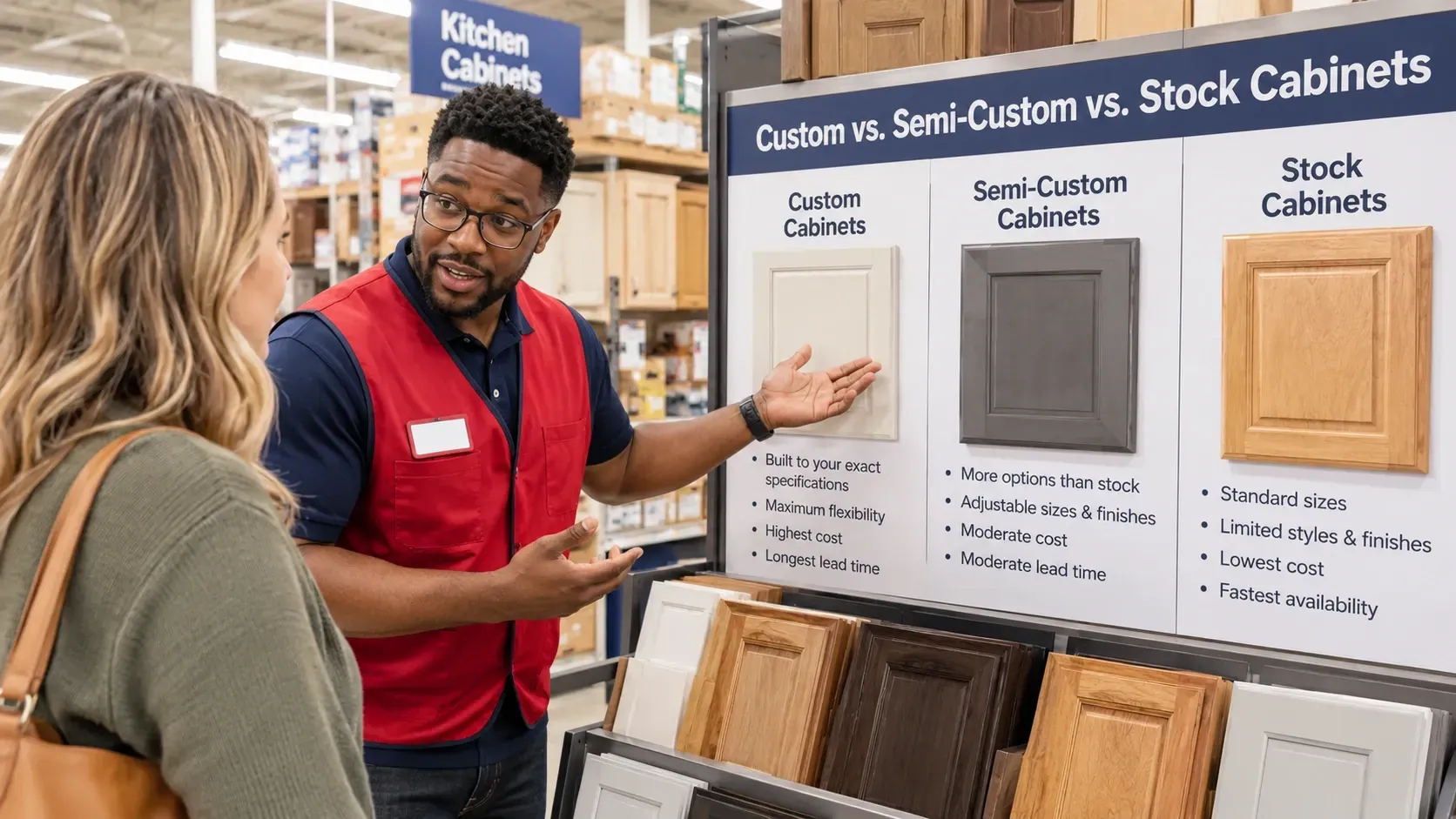
Table of Contents
- Introduction
- What These Cabinet Categories Actually Mean
- Stock, Semi-Custom, and Custom Cabinets Explained
- How They Compare on Price, Lead Time, and Flexibility
- Which Option Fits Different Kitchen Situations
- What Typical Online Advice Overlooks
- A Practical Way to Decide
- Conclusion
- Frequently Asked Questions
Key Takeaways
- Stock cabinets come in set sizes and finishes, which keeps cost and lead time lower but limits how closely they fit an unusual layout.
- Semi-custom cabinets start from standard boxes but allow changes to size, finish, and storage features, landing in the middle on price and wait time.
- Custom cabinets are built to the exact dimensions and specifications of your kitchen, which gives the most flexibility but takes the longest and costs the most.
- Kitchen layout, wall irregularities, and specific storage needs often matter more than budget alone when choosing between the three.
- Lead time differences between categories can be significant, so the choice affects project scheduling as much as the final look.
Introduction
Stock kitchen cabinets come in preset sizes and finishes and ship fastest, semi-custom cabinets allow some changes to size and features with a moderate wait, and custom cabinets are built to your kitchen's exact specifications but take the longest and cost the most. The right choice usually comes down to how unusual your kitchen's layout is, how specific your storage needs are, and how much lead time your project can accommodate. Anyone planning a kitchen remodel in Newburgh or nearby towns will likely run into this decision early, since cabinets affect both the budget and the schedule for the rest of the project.
The terms get used loosely by different retailers, which adds confusion. One company's "semi-custom" line might offer more flexibility than another's "custom" option. Understanding what separates these three categories in practice, rather than by name alone, makes it easier to compare quotes and set realistic expectations.
This guide walks through what each category actually includes, how they stack up against each other, and which situations tend to favor one over the others.
What These Cabinet Categories Actually Mean
Cabinet manufacturers build in standard sizes using modular components. The differences between stock, semi-custom, and custom come down to how much that standard process can be adjusted.
Stock cabinets are manufactured in bulk at fixed dimensions, typically in three-inch increments, with a limited set of finishes and door styles. They are kept in inventory or built on a short production schedule, which is why they are usually the fastest option to get.
Semi-custom cabinets start from the same modular base as stock, but manufacturers open up more choices. Width can sometimes be adjusted in smaller increments, finishes expand, and add-ons like pull-out shelves or specialty organizers become available. The cabinets are still built to order rather than pulled from existing inventory.
Custom cabinets are built from scratch to the measurements and specifications of a specific kitchen.
Stock, Semi-Custom, and Custom Cabinets Explained
Stock Cabinets
Stock cabinets are pre-built in standard sizes, which keeps cost and lead time lower but limits how well they fit irregular spaces.
Because they are manufactured ahead of demand or on a short cycle, stock cabinets are often available within a couple of weeks. The trade-off is fit. If your kitchen has an unusual corner, an odd ceiling height, or a layout that doesn't match standard dimensions, stock cabinets may leave gaps that need filler panels to look finished.
Semi-Custom Cabinets
Semi-custom cabinets modify the standard stock process to allow more sizing flexibility and additional features, landing in the middle on both price and lead time.
This category is popular because it offers meaningfully more choice without the full cost of custom work. Homeowners can usually select from a wider range of door styles, wood species, and finishes, along with functional additions like soft-close drawers, spice pull-outs, or trash can cabinets.
Lead times for semi-custom cabinets are generally longer than stock, since each order is built to the selected specifications rather than pulled from a standard catalog.
Custom Cabinets
Custom cabinets are built to the exact measurements and design of your kitchen, offering the most flexibility but requiring the most time and the highest budget.
Every dimension, material choice, and storage detail can be specified, which makes custom cabinets the right fit for unusual layouts, built-in appliances that need precise clearances, or kitchens where no standard size works well.Custom kitchen cabinets are typically built by a cabinet shop working directly from the kitchen's measurements rather than a factory catalog.
Because each order starts from scratch, lead times run considerably longer than semi-custom, and the labor involved in custom fabrication adds cost accordingly.
How They Compare on Price, Lead Time, and Flexibility
Price generally rises as flexibility increases. Stock is the most affordable, semi-custom sits in the middle, and custom carries the highest price per linear foot.
Lead time follows a similar pattern. Stock cabinets are often the quickest to receive, semi-custom typically takes several weeks longer, and custom cabinets usually require the longest wait because fabrication starts from raw material rather than a standard template.
Flexibility is where the categories diverge the most. Stock offers the least room for adjustment, semi-custom allows meaningful changes within a defined set of options, and custom removes most of those limits entirely. The right balance depends on how much your kitchen's layout or your storage goals actually require that flexibility.
Which Option Fits Different Kitchen Situations
Straightforward, standard-sized kitchens. Stock cabinets often work well here.
Kitchens with some unusual elements. Semi-custom tends to fit kitchens with a few irregular spots,.
Kitchens with significant layout challenges. Custom cabinets make more sense when a kitchen has sloped ceilings, unusual angles, or a design that depends on cabinetry fitting a very specific space.
Business and rental properties. Business owners managing multiple units or commercial kitchen spaces often lean toward stock or semi-custom for cost control and faster turnaround, reserving custom work for spaces with particular design or functional requirements.
Budget-focused projects. Stock cabinets paired with upgraded hardware or countertops can sometimes achieve a similar look to semi-custom at a lower overall cost.
What Typical Online Advice Overlooks
Generic comparisons often stop at price and miss a few practical details.
Terminology varies by retailer. What one company calls semi-custom might be closer to stock elsewhere, or closer to custom. Looking at the actual range of sizing and finish options matters more than the label used.
Lead time affects the whole project schedule. If cabinets are the long pole in your timeline, ordering early during the planning phase prevents the rest of your remodel from stalling while you wait for delivery.
Filler panels and fit matter more than people expect. A kitchen that looks fine with stock cabinets in photos can end up with visible gaps or awkward filler strips once installed, particularly in older homes with walls that are not perfectly square.
Resale and long-term plans can factor in. For a home you plan to sell within a few years, stock or semi-custom may offer better value. For a kitchen meant to last decades in a forever home, the added cost of custom work may be easier to justify.
Mixing categories is sometimes an option. Some homeowners use semi-custom for the main run of cabinets and a custom piece for one unusual spot, like an island or a corner unit, rather than committing fully to one category throughout the kitchen.
A Practical Way to Decide
Work through these questions before committing to a category.
- How standard is your kitchen's layout? A conventional layout with typical wall lengths points toward stock or semi-custom. Unusual angles or dimensions point toward semi-custom or custom.
- What is your timeline? If your project has a firm end date, stock's shorter lead time may be the deciding factor.
- How specific are your storage needs? Specialty organizers, unusual appliance placements, or particular drawer configurations often point toward semi-custom or custom.
- What is your budget ceiling? Custom cabinets require the most room in the budget, so confirming what you can realistically spend narrows the options quickly.
Here is a hypothetical example. Picture a galley kitchen in an older Newburgh home with a slightly uneven wall at one end. Stock cabinets might leave a visible gap at that wall. Semi-custom, with an adjusted width for that one section, could solve the problem without the cost of a fully custom kitchen. This is an illustration, not a rule, and a different kitchen could point to a different answer.
Conclusion
Stock, semi-custom, and custom kitchen cabinets differ mainly in how much the standard manufacturing process can be adjusted, and that difference drives price, lead time, and how well the cabinets fit an individual kitchen. Stock is the fastest and most affordable but least flexible, semi-custom offers a middle ground with more choice, and custom removes most limits at the highest cost and longest wait.
The right category depends on your kitchen's layout, your timeline, and how specific your storage needs are, more than on price alone. Comparing actual options and specifications, rather than relying on category names, leads to a more informed decision.
Have Questions About Cabinet Options for Your Kitchen?
If you're weighing stock, semi-custom, and custom cabinets for a kitchen project and want input specific to your layout, talking with someone familiar with local kitchens can help narrow the options. Wall irregularities, appliance placement, and timeline all affect which category makes sense, and a look at the actual space often settles questions that general comparisons can't.
Day One Custom Painting & Renovations works with homeowners and business owners in Newburgh, NY and nearby communities. If you'd like to talk through your kitchen project,
reach out and ask about cabinet options, timelines, or budget ranges. You can also call (845) 728-5477. Cabinet decisions often tie into broader
painting and renovations plans, so it helps to mention anything else you're considering for the space.
Frequently Asked Questions
Q1: Are semi-custom cabinets worth the extra cost over stock?
It depends on your kitchen. If your layout is standard and stock sizes fit well, the extra cost of semi-custom may not add much value. If you need specific sizing or features stock doesn't offer, semi-custom can solve those gaps without the full cost of custom work.
Q2: How much longer does it take to get custom cabinets compared to stock?
Lead times vary by manufacturer and shop, but custom cabinets generally take considerably longer than stock since each order is built from raw materials rather than pulled from a standard catalog. Confirming lead time directly with your supplier early in planning helps avoid scheduling surprises.
Q3: Can I mix stock and custom cabinets in the same kitchen?
Yes, some homeowners use stock or semi-custom for most of the kitchen and a custom piece for one unusual spot, such as an island or an oddly shaped corner. This can balance cost against the need for a precise fit in specific areas.
Q4: Do stock cabinets look lower quality than custom ones?
Not necessarily. Quality depends on construction method, materials, and hardware rather than category alone. A well-built stock cabinet from a reputable manufacturer can hold up as well as a custom piece, though finish and design options are more limited.
Q5: What should business owners consider differently when choosing cabinets?
Business owners managing rental units or commercial kitchens often prioritize cost control and faster turnaround, which tends to favor stock or semi-custom. Custom work is usually reserved for spaces with specific design requirements or unusual layouts that standard options can't accommodate.
Recent Posts